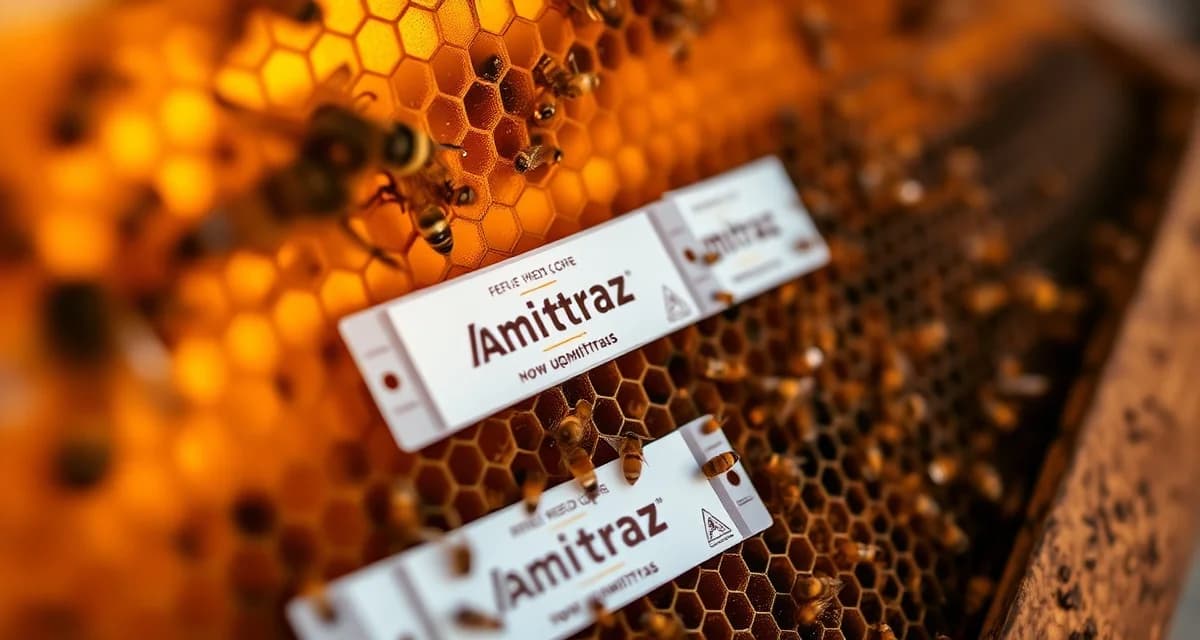
Amitraz Varroa Treatment Guide: Apivar Strip Application and Log
Amitraz is one of the most effective varroa treatments available to US beekeepers. Apivar, the amitraz strip product registered in the US, consistently achieves 90%+ mite kill when applied correctly. That's among the highest efficacy rates of any miticide in the treatment toolkit.
But "when applied correctly" is doing a lot of work in that sentence. Amitraz resistance is real and growing. Apivar has documented resistance in some European varroa populations, and US resistance cases are increasing. An amitraz varroa treatment guide that doesn't address resistance monitoring is incomplete.
This guide covers the full protocol: application, strip removal timing, efficacy verification, and how to detect early resistance signals before they become a problem.
TL;DR
- Apivar (amitraz) strips should run for a full 42-day treatment window for maximum efficacy
- Apply 1 strip per 5 frames of bees, placed between frames in the brood nest
- Do not use Apivar when honey supers are present; observe PHI requirements before adding supers
- Amitraz does not penetrate capped brood, so the full 42 days is needed to catch emerging mites
- Track pre- and post-treatment mite counts to calculate efficacy and detect early resistance
- VarroaVault stores efficacy scores per cycle so resistance trends are visible across years
How Amitraz Works
Amitraz is a formamidine acaricide. It works by activating octopamine receptors in the mite's nervous system, causing hyperactivity, detachment from bees, and death. Unlike contact-only treatments, amitraz has a vapor phase component, it also kills mites that don't directly contact the strip.
The strip format (Apivar) releases amitraz slowly over the treatment period, maintaining lethal concentration in the hive for the full 42-56 days. The slow release is what gives amitraz its high efficacy: mites are continuously exposed throughout the treatment window, including mites that emerge from brood cells partway through the treatment period.
Apivar Application Protocol
Before Applying
- Remove all honey supers. Apivar cannot be used with supers on.
- Perform a baseline mite count (alcohol wash or sugar roll) within 1-2 weeks of application. This is the number you'll compare your post-treatment count against.
- Check your treatment history. If you've used Apivar in both of the last two treatment cycles, switch treatment classes first and revisit amitraz later. Continuous amitraz use accelerates resistance development.
Strip Placement
Use 2 strips per colony in a standard configuration. Strip placement is the single most important determinant of efficacy, strips not placed in the brood nest deliver poor results.
Place strips:
- Vertically, hanging in the bee space between frames
- In the center of the brood nest, typically frames 3-4 and 6-7 in a 10-frame box
- Where the highest bee traffic occurs
For two-box colonies where brood spans both boxes, one strip per box in the brood nest zone is more effective than two strips in one box.
Log the Application
Record: date, colony ID, strip lot number (useful if you have an efficacy question later), baseline mite count, and number of strips. VarroaVault's Apivar checklist logs all of these and schedules your strip removal reminder automatically.
How Do I Apply Apivar Strips Correctly?
The key steps:
- Wear gloves. Amitraz can irritate skin.
- Remove strips from packaging and hold them by the tabs.
- Hang each strip between two brood frames, perpendicular to the top bars, so the strip body makes contact with both adjacent frame faces.
- Push the attachment tab over the top bar to secure the strip.
- Close the hive.
Do not fold, cut, or modify strips. The release rate is calibrated for the full strip geometry. Modifications alter the effective dose.
Strip Removal Timing
Minimum: 42 days. Less than 42 days means an incomplete treatment that potentially selects for resistance without fully knocking down the mite load.
Maximum: 56 days. After 56 days, efficacy has declined and continued exposure increases wax residue accumulation without additional benefit.
Target: 6-8 weeks (42-56 days). Most beekeepers target the middle of this window.
Set a calendar reminder when you apply. This is one of those tasks that's easy to let slip past the 56-day mark when apiaries are busy in summer.
When Should I Remove Apivar Strips?
Remove strips at 42-56 days from application. Dispose of used strips according to the label, do not bury them near waterways. Wear gloves for removal.
After removing strips, begin the PHI countdown before adding honey supers. Apivar requires supers to be removed during treatment; after strip removal, the PHI period begins before you can add supers again.
Resistance Monitoring: The Post-Treatment Count
This is the step that separates informed management from hope.
Perform a mite count 1-2 weeks after strip removal. Compare to your pre-treatment baseline. Acceptable efficacy: 90% or greater reduction.
If your baseline was 4% and your post-treatment count is 0.4% or below, that's a successful treatment. If your baseline was 4% and your post-treatment count is 2%+, something went wrong, or you're looking at early resistance.
VarroaVault's resistance efficacy check triggers if your post-treatment count doesn't drop by at least 90% from baseline. That's a specific threshold, not a vague concern.
How Does VarroaVault Detect Potential Amitraz Resistance?
The app compares your pre-treatment baseline to your post-treatment count. If the calculated efficacy is below 90%, the resistance alert fires. It doesn't definitively confirm resistance, there are other explanations for poor results (placement error, reinfestation, short treatment period), but it flags the pattern for investigation.
If you see the resistance alert:
- Review your application record. Were strips placed in the brood nest zone? Did you leave them the full 42+ days?
- Check for reinfestation. Is there a feral colony or poorly managed neighbor within 2 miles?
- If application was correct and reinfestation isn't likely, consider contacting your state apiarist or a university extension specialist.
- Switch treatment classes for the next cycle. Do not run another amitraz treatment immediately after a suspected failure.
Apivar Amitraz Resistance: The Growing Picture
Amitraz resistance in varroa was first documented at scale in Eastern Europe in the early 2010s. The mechanism is genetic, specific mutations in the octopamine receptor gene that reduce amitraz binding. Once those mutations are present in a mite population, they're heritable.
In the US, confirmed resistance cases were initially rare but are increasing in reports from several states. The pattern mirrors what happened in Europe before resistance became widespread: sporadic cases that weren't fully investigated, continued amitraz use, and gradual resistance spread.
The protective strategy is rotation. Amitraz one or two cycles, then oxalic acid or formic acid, then back. This prevents the continuous selection pressure that accelerates resistance development.
Treatment Rotation Planning
Amitraz works best as part of a rotation, not as the default treatment every cycle. A reasonable rotation pattern:
- Cycle 1 (spring): Organic, OA extended protocol or formic acid
- Cycle 2 (fall): Synthetic, Apivar
- Cycle 1 following year: Organic
- Cycle 2: Alternate synthetic (Apistan) or organic
This keeps amitraz in the rotation without creating continuous selection pressure. For a complete rotation planning tool, the [treatment rotation planner](/treatment-rotation-planning) tracks your history and suggests the next cycle's class.
For resistance tracking specifically, the mite resistance management guide covers the full resistance detection and response framework.
How do I apply Apivar strips correctly?
Remove strips from packaging with gloves on. Hang each strip vertically in the bee space between frames in the center of the brood nest, with the strip body contacting both adjacent frame surfaces. Use 2 strips per colony in a standard single-box brood area, or one per box in a two-box brood nest. Secure each strip by pushing the attachment tab over the top bar. Do not fold, cut, or modify strips. Log the application date and baseline mite count before closing the hive.
When should I remove Apivar strips?
At 42-56 days from application. The minimum of 42 days is required for full efficacy, pulling strips earlier creates an incomplete treatment. The maximum of 56 days prevents excessive wax residue accumulation. Most beekeepers target 6-8 weeks. After removal, the PHI period begins before honey supers can be added.
How does VarroaVault detect potential amitraz resistance?
VarroaVault compares your logged post-treatment count to your pre-treatment baseline. If the efficacy calculation is below 90% reduction, the resistance alert triggers. The app doesn't diagnose resistance definitively, it flags the pattern for investigation. Your application record is reviewed alongside the efficacy result to distinguish potential resistance from application errors or reinfestation. Consistently low efficacy across multiple treated colonies with confirmed correct application is the clearest signal worth reporting to your state apiarist.
How do I know if my varroa treatment is working?
Run a mite count 2-4 weeks after the treatment ends and compare it to your pre-treatment count. The efficacy formula is: ((pre-count - post-count) / pre-count) x 100. A result above 90% indicates effective treatment. Results below 80% should trigger investigation for possible resistance, application error, or reinfestation. Log both counts in VarroaVault to track efficacy trends across treatment cycles.
How often should I check mite levels in my hives?
At minimum, once per month (every 3-4 weeks) during the active season. Increase to every 2 weeks when counts are near threshold or after a treatment to verify it worked. In fall, monitoring frequency matters most because the window to treat before winter bees are raised is narrow. VarroaVault's monitoring reminders can be set to your preferred interval for each apiary.
What records should I keep for varroa management?
Each record should include: date of count or treatment, hive identifier, monitoring method used, number of bees sampled, mites counted, infestation percentage, treatment product name and EPA registration number, dose applied, treatment start and end dates, and PHI end date. State apiarists typically expect this level of detail during inspections. VarroaVault captures all of these fields in a single log entry.
FAQ
What is Amitraz Varroa Treatment Guide: Apivar Strip Application and Log?
Apivar strip application for varroa management is a complete protocol for treating Varroa destructor mite infestations using amitraz-impregnated plastic strips. Apivar is the only EPA-registered amitraz product for US beekeepers. The guide covers correct strip placement, treatment duration, removal timing, and efficacy verification. It also addresses amitraz resistance monitoring, which is increasingly relevant as resistance cases grow in US apiaries. VarroaVault logs treatment data to help beekeepers track mite kill rates across treatment cycles.
How much does Amitraz Varroa Treatment Guide: Apivar Strip Application and Log cost?
The Apivar strips themselves typically cost $20–$35 for a pack of 10 strips, available through beekeeping suppliers. Each strip treats roughly 5 frames of bees, so a two-story colony may need 2 strips per treatment cycle. The protocol guidance and treatment logging on VarroaVault is free to use. Given that untreated varroa infestations routinely collapse colonies, the cost-per-hive is modest compared to the expense of replacing lost bees and equipment.
How does Amitraz Varroa Treatment Guide: Apivar Strip Application and Log work?
Amitraz works by disrupting the nervous system of Varroa destructor mites, causing detachment from bees and death. Strips are placed directly in the brood nest, where bees contact the amitraz and distribute it through the colony. Because amitraz does not penetrate capped brood, the full 42-day treatment window is required to expose mites emerging from brood cells throughout multiple capping cycles. Pre- and post-treatment mite washes confirm whether the treatment achieved the expected 90%+ kill rate.
What are the benefits of Amitraz Varroa Treatment Guide: Apivar Strip Application and Log?
Apivar consistently delivers among the highest varroa kill rates available — routinely 90% or better when applied correctly. Unlike heat-based or oxalic acid treatments, amitraz strips work passively over six weeks without repeated beekeeper intervention. The protocol also integrates resistance monitoring, so beekeepers catch efficacy decline early. Logging treatment outcomes in VarroaVault creates a longitudinal record that helps identify resistance trends and supports evidence-based decisions about rotating to alternative miticides when needed.
Who needs Amitraz Varroa Treatment Guide: Apivar Strip Application and Log?
Any beekeeper managing colonies with Varroa destructor mites needs a reliable acaricide protocol, and Apivar suits most production and hobbyist contexts. It is especially valuable for beekeepers who have struggled with inconsistent results from other treatments or who want a high-efficacy option with a clearly defined application window. Beekeepers in regions where amitraz resistance has been documented should pair Apivar use with rigorous post-treatment mite counts and consider rotation plans as a precaution.
How long does Amitraz Varroa Treatment Guide: Apivar Strip Application and Log take?
The active treatment window is 42 days. Strips should remain in the hive for the full duration — removing them early reduces efficacy because mites continue to emerge from capped brood throughout the cycle. Add roughly a week on each end for mite counts: a pre-treatment wash before placing strips, and a post-treatment wash 48–72 hours after strip removal. Total time from first count to confirmed result is approximately 7–8 weeks per treatment cycle.
What should I look for when choosing Amitraz Varroa Treatment Guide: Apivar Strip Application and Log?
Prioritize correct strip placement in the brood nest, not near the walls or empty frames. Confirm you are outside the honey flow and have removed supers before treatment, as amitraz contamination in honey is a serious concern. Choose a protocol that mandates a full 42-day run — shorter durations compromise kill rates. Look for logging tools that calculate efficacy percentage automatically. If you are in an area with documented amitraz resistance, a guide that covers resistance signals and miticide rotation is essential.
Is Amitraz Varroa Treatment Guide: Apivar Strip Application and Log worth it?
Yes, for most US beekeepers Apivar remains one of the most reliable varroa management tools available. A 90%+ kill rate, passive application, and a well-defined treatment window make it practical at any scale. The main caveats are resistance management and honey super timing — both of which are straightforward to handle with proper planning. Tracking efficacy each cycle adds only a few minutes of work and pays off significantly if resistance begins developing in your apiary.
Sources
- American Beekeeping Federation (ABF)
- USDA ARS Bee Research Laboratory
- Honey Bee Health Coalition
- Penn State Extension Apiculture Program
- Project Apis m.
Get Started with VarroaVault
Amitraz (Apivar) is one of the most effective varroa treatments available when applied correctly and monitored for efficacy. VarroaVault logs your treatment dates, calculates efficacy from your pre/post counts, and alerts you when results suggest rotation is needed. See pricing and free tools at varroavault.com.