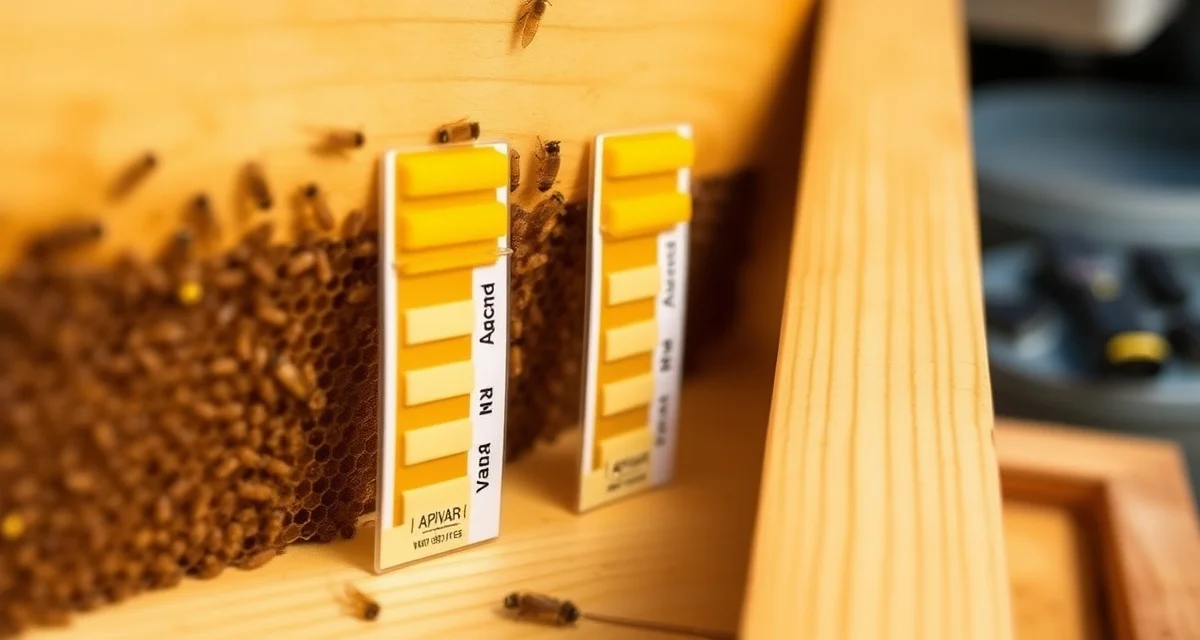
How to Use Apivar Correctly: Application, Timing, and Removal
Apivar strips left beyond 56 days do not increase efficacy but significantly increase amitraz wax residue levels. This is the most commonly violated Apivar label instruction, and it's the one with the most serious long-term consequences for your operation.
This guide covers every step of Apivar application, from opening the package to logging the removal in VarroaVault.
TL;DR
- Place Apivar strips in the brood nest between frames, not in the honey super
- Use 1 strip per 5 frames of bees; do not underdose as this accelerates resistance development
- Leave strips in for the full 42 days; removing early reduces efficacy and contributes to resistance
- Remove strips before adding honey supers; check your state's PHI requirements
- Calculate pre- and post-treatment mite counts to verify the treatment worked as expected
- VarroaVault tracks your Apivar application history and flags when efficacy drops below 90%
What Apivar Is and How It Works
Apivar contains amitraz, an acaricide that works by disrupting the octopamine nervous system in mites. It's delivered through a slow-release plastic strip that bees contact as they move through the hive. The amitraz transfers from the strip to the bees and then to mites via contact.
Apivar is highly effective when used correctly: 95%+ efficacy against susceptible mite populations in properly placed, full-duration treatments. The "properly placed" and "full-duration" parts are where most mistakes happen.
Before You Start: What You Need
- Apivar strips (2 per hive)
- Nitrile gloves (required when handling strips)
- Hive tool
- VarroaVault open on your phone for logging
- Your pre-treatment mite count from the previous 48-72 hours
When NOT to use Apivar:
- When honey supers are on or if you plan to add supers during the treatment period
- If you're in a certified organic operation (Apivar is prohibited under USDA NOP)
- If local resistance data shows amitraz resistance is common in your area
Step 1: Perform a Pre-Treatment Count
An alcohol wash or sugar roll 48-72 hours before application gives you the baseline you need for efficacy calculation. Log it in VarroaVault as a pre-treatment count.
If your count is at threshold (2-3% or above depending on season), treat. If you're below threshold but rising and within 14 days of your projected breach, treat. If you're below threshold with a stable or declining trend, hold off and count again in 2 weeks.
Step 2: Prepare the Hive
Remove honey supers before applying Apivar. The label prohibits application when supers are in place for honey production. This is both a legal requirement and a practical one: amitraz in honey is a significant residue concern.
No other hive preparation is required for Apivar. Unlike formic acid or thymol, Apivar doesn't require specific temperature conditions for application. You can apply at any reasonable working temperature (above 45-50°F for safe hive opening).
Step 3: Unwrap and Activate the Strips
Apivar strips come in sealed foil packets. Wear gloves when opening and handling. The strips are plastic with amitraz impregnated throughout; they don't require activation, but they should be placed in the hive within 1 hour of opening the package.
Each strip should be scored or perforated slightly with your hive tool just before placement to increase surface area. This improves amitraz release rate and treatment efficacy.
Step 4: Position the Strips Correctly
This is the step most often done incorrectly. The strips must be in direct contact with the bee cluster to work. Bees that contact the strip transfer amitraz to their nestmates through grooming.
Correct placement:
- Place one strip between frame 3 and frame 4 from the left
- Place the second strip between frame 7 and frame 8 from the left (or equivalent spacing)
- Strips hang from the top bar, hanging between frames, making contact with bees on both adjacent frames
- The strip should hang fully into the cluster area where brood is present
Incorrect placement:
- Strips placed at the outer edges of the box (bees don't contact them)
- Strips lying flat on the bottom board (not in the cluster)
- Both strips clustered near each other in the same center location (single contact zone instead of two)
Step 5: Log the Treatment in VarroaVault
Immediately after applying the strips, log the treatment in VarroaVault:
- Product: Apivar (amitraz)
- Date: today
- Dose: 2 strips
- Hive: select from your list
- Applicator: your name or employee name
VarroaVault automatically calculates:
- Day 42 reminder: check strips and perform first efficacy count
- Day 56 reminder: final removal deadline
These reminders fire as SMS and email alerts based on your notification settings.
Step 6: Leave Strips in Place for 42-56 Days
Apivar works slowly. The amitraz continues killing mites through contact over the full treatment period. Unlike OA vaporization (where efficacy peaks quickly), Apivar's power comes from the sustained release over 6-8 weeks.
Do not remove strips early. Early removal before day 42 dramatically reduces total mite kill. The label minimum is 42 days.
Do not leave strips beyond 56 days. Strips left beyond 56 days don't kill more mites (the amitraz is largely depleted by this point), but they do leach increased amounts of amitraz into beeswax. Wax contamination from prolonged strip exposure is a documented problem in operations that neglect strip removal.
Step 7: Perform a Post-Treatment Efficacy Count
At day 42, before removing strips, perform a mite count. Log it in VarroaVault. The app calculates your efficacy percentage against your pre-treatment baseline.
If your efficacy is above 90%: excellent. Remove strips by day 56.
If your efficacy is 75-89%: acceptable, but worth investigating. Consider whether placement was correct. Check if reinfestation may have occurred. Remove strips by day 56.
If your efficacy is below 75%: possible resistance signal. Report to your state apiarist. Remove strips by day 56 regardless.
Step 8: Remove the Strips
Remove both strips by day 56. Don't leave one in place if you can't find the other. Dispose of used strips in household trash (not compost or burn pile).
After strip removal, log the removal date in VarroaVault. The app closes the treatment record and clears any remaining Apivar-related reminders.
Step 9: Add Supers When Appropriate
You can add honey supers after strips are fully removed and there is no remaining concern about residual amitraz exposure. The Apivar label doesn't specify a PHI after strip removal for supers, but it's prudent to wait at least 2 weeks after removal before adding supers to a colony that had extended strip exposure.
Frequently Asked Questions
Where do I place Apivar strips in the hive?
Place one strip between frames 3 and 4 and a second strip between frames 7 and 8 of the brood box, hanging from the top bar into the cluster area. The strips must make direct contact with bees. Strips placed at the hive edges or outside the cluster area significantly reduce efficacy.
When do I remove Apivar strips?
Apivar strips should be removed no earlier than day 42 and no later than day 56 after application. Leaving strips beyond 56 days doesn't increase mite kill but does increase amitraz wax residue accumulation, which can persist in comb for years.
Does VarroaVault remind me to remove my Apivar strips?
Yes. When you log an Apivar application, VarroaVault automatically schedules a day-42 reminder to check efficacy and a day-56 removal deadline reminder. Both reminders are sent via SMS and email based on your notification settings.
How do I know if my varroa treatment is working?
Run a mite count 2-4 weeks after the treatment ends and compare it to your pre-treatment count. The efficacy formula is: ((pre-count - post-count) / pre-count) x 100. A result above 90% indicates effective treatment. Results below 80% should trigger investigation for possible resistance, application error, or reinfestation. Log both counts in VarroaVault to track efficacy trends across treatment cycles.
How often should I check mite levels in my hives?
At minimum, once per month (every 3-4 weeks) during the active season. Increase to every 2 weeks when counts are near threshold or after a treatment to verify it worked. In fall, monitoring frequency matters most because the window to treat before winter bees are raised is narrow. VarroaVault's monitoring reminders can be set to your preferred interval for each apiary.
What records should I keep for varroa management?
Each record should include: date of count or treatment, hive identifier, monitoring method used, number of bees sampled, mites counted, infestation percentage, treatment product name and EPA registration number, dose applied, treatment start and end dates, and PHI end date. State apiarists typically expect this level of detail during inspections. VarroaVault captures all of these fields in a single log entry.
What is How to Use Apivar Correctly: Application, Timing, and Removal?
This is a complete guide to using Apivar strips for varroa mite control in honey bee colonies. It covers proper strip placement in the brood nest, correct dosing (1 strip per 5 frames of bees), the required 42-56 day treatment window, and safe removal before adding honey supers. The guide also explains how to calculate pre- and post-treatment mite counts to confirm the treatment worked effectively.
How much does How to Use Apivar Correctly: Application, Timing, and Removal cost?
Apivar strips are a purchased beekeeping treatment, not a service with a subscription fee. Pricing varies by supplier and quantity, but the guide focuses on correct application rather than cost. Improper use—such as leaving strips in too long or underdosing—can lead to amitraz wax residue buildup and accelerated mite resistance, which carry far greater long-term costs to your operation than the strips themselves.
How does How to Use Apivar Correctly: Application, Timing, and Removal work?
Apivar strips contain amitraz, an acaricide that disrupts the octopamine nervous system in varroa mites. The strips slowly release amitraz inside the hive; as bees move through the brood nest and contact the strips, amitraz transfers to their bodies and then to mites via direct contact. Strips must remain in the brood nest for the full treatment period—removing them early reduces efficacy and contributes to resistance development.
What are the benefits of How to Use Apivar Correctly: Application, Timing, and Removal?
When used correctly, Apivar delivers highly effective varroa control with minimal disruption to colony management. Benefits include a straightforward application process, a proven slow-release delivery mechanism, and compatibility with VarroaVault tracking to monitor efficacy over time. Following label instructions—correct dosing, full treatment duration, and timely removal—protects your colonies from mite overload while reducing the risk of amitraz resistance and wax residue accumulation.
Who needs How to Use Apivar Correctly: Application, Timing, and Removal?
Any beekeeper managing colonies with varroa mite pressure should understand correct Apivar use. It's especially critical for those who have experienced treatment failures, noticed declining efficacy, or are unsure about proper dosing and timing. New beekeepers benefit from the step-by-step application guidance, while experienced beekeepers will find value in the resistance-prevention advice and VarroaVault integration for tracking treatment history and flagging drops below 90% efficacy.
Related Articles
Sources
- American Beekeeping Federation (ABF)
- USDA ARS Bee Research Laboratory
- Honey Bee Health Coalition
- Penn State Extension Apiculture Program
- Project Apis m.
Get Started with VarroaVault
The information in this guide is most useful when you have your own mite count data to apply it to. VarroaVault stores every count, flags threshold crossings automatically, and builds the treatment history you need for state inspections and effective management decisions. See pricing and free tools at varroavault.com.