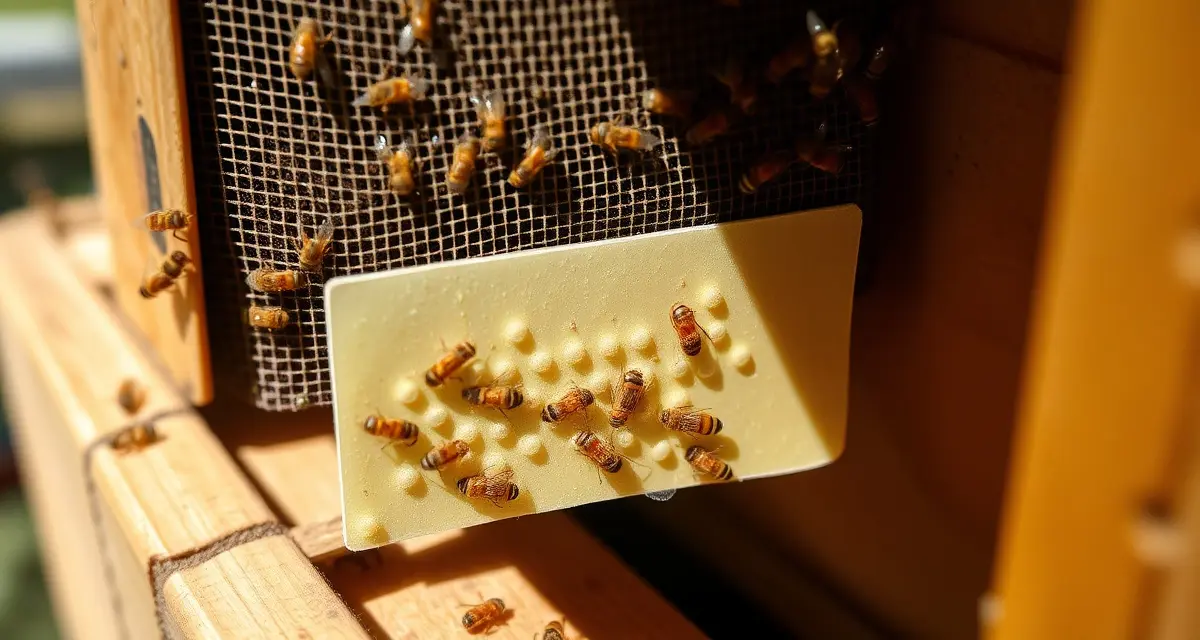
How to Use a Sticky Board for Varroa Mite Monitoring
The sticky board is the oldest monitoring method in the beekeeper's toolkit. You slide a sticky surface under a screened bottom board, wait 24 or 72 hours, and count the mites that fell. No bee deaths. No alcohol. No sample collection. Just passive monitoring.
It's simple. It's also routinely misinterpreted.
A 24-hour sticky board count of 10 or more mites suggests a colony is approaching the 2% summer threshold. But converting that drop count to an actionable infestation estimate requires a conversion factor, and the conversion factors vary by season, colony size, and even geographic region. Many beekeepers count mites on the board and have no idea whether 8 mites is fine or concerning.
This guide covers the full sticky board method: setup, interpretation, conversion, logging, and when to use it versus when to switch to alcohol wash.
TL;DR
- A valid mite count sample requires approximately 300 bees from the brood nest for statistically reliable results
- Alcohol wash is 15-20% more accurate than sugar roll for detecting mite infestation levels
- The calculation is: (mites counted / bees in sample) x 100 = infestation percentage
- A 2% threshold triggers treatment in spring/summer; 1% is the fall action threshold
- Count at least once per month during active season; increase to every 2 weeks if levels are near threshold
- Log every count in VarroaVault to build a trend dataset that shows whether populations are rising or stable
What Is a Sticky Board?
A sticky board (also called a mite drop board or mite count board) is a piece of cardboard, coroplast, or paper coated with a sticky substance, usually petroleum jelly (Vaseline), cooking spray, or a commercial tacky product. It's inserted below a screened bottom board and collects mites that fall through the screen from the colony above.
Varroa mites fall naturally from bees during grooming, emergence, and movement. The sticky board captures those fallen mites and gives you a count of natural mite drop over the monitoring period.
Setup: What You Need
- A screened bottom board on your hive (the screen is necessary, a solid bottom board won't work)
- A board-sized piece of cardboard or coroplast
- Petroleum jelly, cooking spray, or commercial sticky coating
- A ruler or grid overlay (makes counting easier)
- 24 or 72 hours of patience
Preparing the Board
Coat the board evenly with petroleum jelly or cooking spray. You want a consistent tacky surface that holds mites in place without being so thick that they sink and become hard to see.
Optionally, draw or print a grid pattern on the board before coating, counting mites in small squares is faster and less prone to error than scanning the whole board at once.
Inserting the Board
Slide the prepared board into the bottom slot of your screened bottom board. The board should slide in from the rear of the hive without disturbing the colony.
Note the time you inserted it.
How Long Should the Sticky Board Stay In?
24-hour count: The standard for most monitoring purposes. Insert in the morning, remove the next morning. This gives you a day's natural mite drop.
72-hour count: Used when mite drop is very low and you want more mites to count for a reliable estimate, or in cool weather when drop rates are naturally lower. Divide the 72-hour count by 3 to get your daily drop rate.
Avoid leaving boards in during heavy rain or high humidity, condensation can wash mites off the board or make them harder to identify.
Counting Mites on the Board
Remove the board and count mites in good light. Varroa mites appear as small reddish-brown oval specks, about 1mm long and 1.5mm wide. They're distinctive compared to pollen, wax flakes, and bee debris on the board.
Mites on a sticky board are viewed from below (ventral side), which makes them look slightly different than the familiar dorsal view. Look for the characteristic oval shape and reddish-brown color.
Using a grid overlay, count each square separately. This prevents double-counting and makes it easier to work through a board systematically.
Converting Sticky Board Counts to Infestation Estimates
This is where sticky boards get complicated.
The conversion from daily drop rate to estimated infestation percentage is not fixed, it varies based on:
- Colony size (more bees = more grooming = higher drop rate at same infestation level)
- Season (mite drop rate is higher in summer than fall due to colony activity)
- Temperature and humidity
Commonly used conversion factors:
| Season | Daily mite drop | Approximate % infestation |
|--------|----------------|--------------------------|
| Summer (peak population) | 1-2/day | ~0.5% |
| Summer | 5-10/day | ~1-2% |
| Summer | 10-25/day | ~2-4% |
| Fall (smaller colony) | 5-10/day | ~2-4% |
The sticky board calculator in VarroaVault converts your 24-hour drop count to an estimated infestation percentage using validated conversion factors, adjusting for the season and an estimated colony size you enter.
A 24-hour drop count of 10 or more mites in peak summer suggests a colony approaching the 2% threshold. In fall, the same drop count suggests a higher infestation rate because colony population is smaller.
Is a Sticky Board as Accurate as an Alcohol Wash?
No. The sticky board is a trend monitor, not a precise measurement tool.
Alcohol wash (the gold standard) gives you a direct percentage: you sample 300 bees and count actual mites. That number doesn't require a conversion factor or a season-based adjustment.
Sticky board counts are indirect estimates. They're useful for:
- Confirming mites are present in a colony
- Monitoring trends over time (rising counts signal a problem before you reach threshold)
- Non-lethal monitoring when you prefer not to sacrifice sample bees
- Quick screening across many hives when full counts aren't feasible
They're less appropriate for:
- Treatment threshold decisions (use alcohol wash to confirm before treating)
- Post-treatment efficacy verification (alcohol wash only, the drop count changes too unpredictably after treatment)
- Small sample sizes where a few mites' difference in count considerably changes the estimate
The practical recommendation: use sticky boards for regular monitoring between counts, and switch to alcohol wash when you're making a treatment decision or verifying efficacy.
How Do I Log a Sticky Board Count in VarroaVault?
In the colony record, select "Add Count" and choose "Sticky Board" as the method. Enter:
- Date and time the board was inserted
- Date and time it was removed
- Raw mite count from the board
- Monitoring period (24 or 72 hours)
- Estimated colony size (frames of bees)
VarroaVault calculates the daily drop rate and converts it to an estimated infestation percentage using season-adjusted conversion factors. The result is displayed alongside your alcohol wash counts in the colony's mite count history, clearly labeled as an estimated value rather than a direct measurement.
If your sticky board estimate is approaching the treatment threshold, VarroaVault prompts you to confirm with an alcohol wash before treating.
For precise count methodology, see the mite wash calculator and the mite count tracking app for your full monitoring history.
How do I convert sticky board counts to infestation percentage?
Divide your raw count by the number of hours (24 or 72) to get the daily drop rate. Then apply a season-adjusted conversion factor: approximately 1 mite per day per 100-150 bees during summer in a full colony translates to roughly 0.5-1% infestation. A summer daily drop of 10 mites in a large colony suggests approximately 2% infestation. Conversions are approximate and should be confirmed with an alcohol wash before making a treatment decision.
Is a sticky board as accurate as an alcohol wash?
No. The sticky board provides an estimated indirect measure of mite infestation based on natural drop rate. Alcohol wash provides a direct percentage from a sample of actual bees. Sticky boards are useful for trend monitoring, they tell you whether your situation is improving, stable, or deteriorating without killing sample bees. But for treatment threshold decisions and post-treatment efficacy verification, alcohol wash is the appropriate method.
How do I log a sticky board count in VarroaVault?
Open the colony record, select "Add Count," and choose "Sticky Board" as the method. Enter the board insertion and removal times, raw mite count, monitoring period, and estimated colony size. VarroaVault calculates the daily drop rate and season-adjusted infestation estimate automatically. Results appear alongside your alcohol wash counts in the count history, labeled as estimates, and the system prompts alcohol wash confirmation if the estimate approaches the treatment threshold.
How soon after treatment can I run a post-treatment mite count?
Wait 2-4 weeks after the treatment ends before running a post-treatment count. Counting too soon (within a week of treatment removal) may show mites still dying or emerging from the last brood cycle. Waiting 2-4 weeks allows emerging bees from brood that was capped during treatment to fully emerge and any surviving mites to become detectable in a new count.
What should I do if my mite count results seem unusually high or low?
If results seem surprising, repeat the count within 1-2 weeks before making a treatment decision based on a single outlier result. Confirm you sampled from the brood nest center (not outer frames), used the correct sample size (approximately 300 bees), and shook vigorously for the full 60 seconds. Consistent sampling technique is the most important factor in count accuracy.
Can I count mites from a sticky board instead of doing an alcohol wash?
Sticky board counts measure mite fall rate over 24-72 hours, which correlates with infestation level but is not a direct measure of infestation percentage. Sticky board results cannot be converted to an accurate percentage without calibration, and they are less reliable than alcohol wash for treatment decisions. Use sticky boards for general population monitoring but rely on alcohol wash counts for threshold decisions.
FAQ
What is How to Use a Sticky Board for Varroa Mite Monitoring?
Sticky board monitoring is a passive method for tracking varroa mite levels in a honeybee colony. A sticky surface is placed beneath a screened bottom board to catch mites that naturally fall from bees. After 24 to 72 hours, you count the mites on the board and use a conversion factor to estimate the overall infestation rate. It requires no bee handling, no chemicals, and no sampling — making it one of the most beginner-friendly monitoring tools available to beekeepers.
How much does How to Use a Sticky Board for Varroa Mite Monitoring cost?
Sticky boards are inexpensive and often free to make at home. Commercial versions typically cost between $5 and $20. You can create a DIY board using cardboard, cooking spray, or petroleum jelly on a stiff backing that slides under your screened bottom board. The only ongoing cost is the time spent counting. Compared to alcohol wash supplies or commercial testing kits, sticky board monitoring has one of the lowest material costs of any varroa detection method.
How does How to Use a Sticky Board for Varroa Mite Monitoring work?
Slide a sticky board beneath your hive's screened bottom board and leave it in place for 24 or 72 hours. Mites that naturally dislodge from bees fall through the screen and stick to the surface below. After the monitoring period, remove the board and count the mites — small reddish-brown ovals roughly 1–2mm wide. Divide the total by the number of days to get a daily mite drop rate, then apply a seasonal conversion factor to estimate your colony's overall infestation percentage.
What are the benefits of How to Use a Sticky Board for Varroa Mite Monitoring?
Sticky board monitoring is non-lethal, requires no bee removal, and can be done without opening the hive. It gives you a continuous passive snapshot of mite activity and is useful for detecting trends over time. It's especially valuable in cold months when disturbing the cluster is undesirable. When used alongside a conversion factor, it can flag colonies approaching treatment thresholds before infestation levels become critical, giving you time to plan an intervention without the urgency of a crisis count.
Who needs How to Use a Sticky Board for Varroa Mite Monitoring?
Any beekeeper managing colonies on screened bottom boards can use this method. It's particularly well-suited for beginners who aren't yet comfortable with alcohol wash or sugar roll sampling. Hobbyists monitoring a small number of hives will find it low-stress and accessible. It's also useful for experienced beekeepers doing routine seasonal checks or tracking hive trends across multiple colonies. If your bottom board is solid rather than screened, sticky board monitoring is not applicable without modification.
How long does How to Use a Sticky Board for Varroa Mite Monitoring take?
The board itself stays in place for 24 or 72 hours depending on your protocol. A 24-hour drop gives a quicker snapshot, while 72 hours averages out daily fluctuations for a more stable reading. Counting the mites takes 5 to 15 minutes depending on board debris. The full monitoring cycle from setup to recorded result typically takes three days or less. Many beekeepers run boards monthly during peak varroa season and less frequently in winter.
What should I look for when choosing How to Use a Sticky Board for Varroa Mite Monitoring?
Look for a board that fits snugly beneath your specific bottom board without gaps that could allow bees to access it. A grid printed on the surface makes counting easier and more accurate. The sticky coating should hold mites without drying out during the monitoring window — petroleum jelly or commercially coated boards work well. Choose a board made from material that's easy to read against: white or light-colored backgrounds make the reddish-brown mites far easier to spot and count accurately.
Is How to Use a Sticky Board for Varroa Mite Monitoring worth it?
Sticky board monitoring is worth using as a regular part of your varroa management routine, but not as a standalone diagnostic tool. It won't give you the precision of an alcohol wash, and without applying the correct seasonal conversion factor, raw drop counts can be misleading. Used correctly alongside other methods, it helps you detect rising mite pressure early, track trends between more accurate counts, and monitor hives with minimal disruption. Think of it as an early warning system, not a definitive infestation measurement.
Sources
- American Beekeeping Federation (ABF)
- USDA ARS Bee Research Laboratory
- Honey Bee Health Coalition
- Penn State Extension Apiculture Program
- Project Apis m.
Get Started with VarroaVault
An alcohol wash gives you the number. VarroaVault turns that number into a decision. Log your count, get an instant threshold comparison, and build a monitoring history that shows you whether mite levels are rising or stable across your entire operation. See pricing and free tools at varroavault.com.