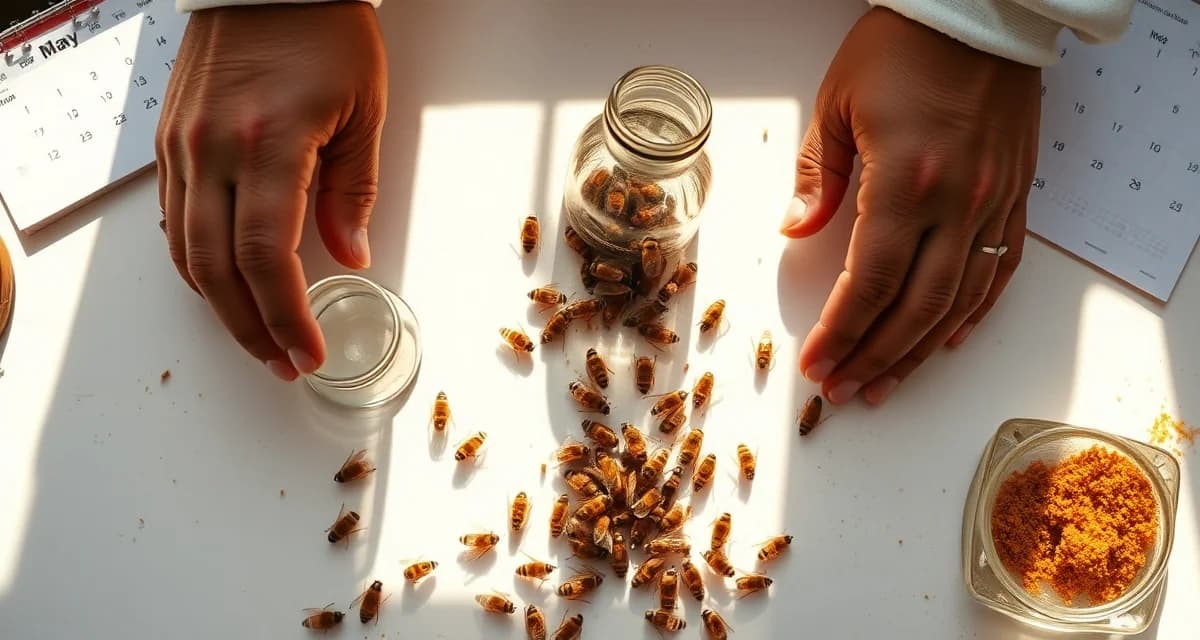
May Varroa Monitoring: Setting Your Baseline for the Season
The May mite count is the most underutilized tool in beekeeping. Most beekeepers know they should test, but May feels too early. Colonies are building beautifully, there's no visible disease, and varroa feels like a fall problem. That intuition is wrong. Colonies at 1% in May have a 70% chance of exceeding threshold by July if no intervention is taken, and colonies that exceed threshold in July are on a trajectory that threatens winter survival.
VarroaVault treats your May count as the seasonal trend starting point for the full management year. Every count after May is measured against it. A July count of 2% reads differently when your May baseline was 0.3% versus when it was 1.4%. That context is what converts raw numbers into actionable intelligence.
TL;DR
- May treatment decisions should be based on a current mite count, not calendar date alone
- Temperature constraints in May may limit which treatments are effective in your climate zone
- PHI timing for May treatments affects when honey supers can be added or must be removed
- Log a mite count before starting any May treatment to calculate efficacy post-treatment
- VarroaVault's treatment reminders for May account for regional temperature and flow calendars
- Recording May treatment dates creates the audit trail needed for state inspection compliance
Why May Counts Matter
Spring colony buildup accelerates mite reproduction in two ways. First, the rapid expansion of brood area gives varroa more cells to reproduce in. Second, the proportion of capped brood increases relative to adult bees, which means a larger fraction of the mite population is in cells and invisible to you during normal inspections. alcohol wash is the only reliable way to see what's actually happening.
May is also the month most likely to reveal whether your winter treatment or spring oxalic acid dribble worked as expected. If you treated in October with OA dribble on a broodless colony and achieved 90% efficacy, your May count should be low. If your May count is already at 1.5-2%, something went wrong: either the treatment didn't fully work, reinfestation occurred over winter, or the colony built up very fast. Any of those scenarios tells you something important.
How to Do Your May Alcohol Wash
Collect 300 adult bees from a brood frame (not honey frames, not the landing board). If the colony is small, collect as many bees as you can find on a brood frame, down to a minimum of 100, and note the sample size for accurate calculation.
Add 70% isopropyl alcohol to cover the bees fully. Shake vigorously for 30-60 seconds. Pour through a mesh into a white container. Count the mites. Divide by the number of bees sampled and multiply by 100 to get your infestation percentage.
A count of 0-0.5% in May is excellent. A count of 0.5-1% is acceptable with a monitoring plan for June. A count of 1-2% warrants a decision about whether to treat now or monitor closely with a June recount. Above 2% in May requires treatment.
Treatment in May: What to Avoid
Avoid Apivar in May if you're planning to run honey supers from late May onward. Apivar requires 42-56 days of application and must be removed before supers go on. If you start Apivar in early May, you're pulling strips in late June at the earliest, which may conflict with your first honey harvest.
Formic acid works in May if temperatures are appropriate. May temperatures in most of the US are within the 50-85F range suitable for MAQS or Formic Pro. With supers not yet on or just going on, you have more flexibility.
OA dribble or vaporization in May is most effective if the colony has a brood break or very limited brood, which is uncommon in May for most colonies. An extended vaporization protocol (3 treatments at 5-day intervals) can work with brood present by catching mites as they emerge.
Building the Seasonal Plan from May
Use your May count to set up your spring mite management calendar. Log the count in your mite count tracking app with your colony ID, the date, the sample size, and the method used. VarroaVault uses that data to project your likely count trajectory through the season and tells you when your next count is due.
Frequently Asked Questions
Why is a May mite count important?
May is when mite populations shift from winter-level stasis to seasonal growth. The count you log in May is your true starting point for the season. Without a May baseline, you have no way to evaluate whether your mite load is growing slowly or rapidly when you count again in July. A 2% July count is alarming if your May baseline was 0.5% and reassuring if your May baseline was 1.8% after a spring treatment. Context is everything, and the May count provides that context. It also gives you maximum lead time to treat before honey flow complications limit your options.
What is a good baseline mite count in May?
Below 1% is ideal for a May baseline. This gives you a comfortable buffer before summer mite population growth pushes you toward threshold. A May count of 0.5% means you likely have 6-8 weeks before you need to act, assuming typical summer growth rates. A May count of 1-2% means you should plan treatment for late May or June before honey supers create PHI complications. Above 2% in May means you've already exceeded the active-season threshold and should treat immediately using a product compatible with your current honey super status.
Does VarroaVault track my May count as a seasonal baseline?
Yes. VarroaVault designates your first count of the season as the seasonal baseline and uses it to calibrate all subsequent count interpretations. If your May count was 0.8%, a July count of 1.6% is flagged as a doubling within the expected range. If your July count jumps to 3.2%, that's flagged as above-expected growth that warrants investigation: possible spring treatment failure, reinfestation, or rapid colony expansion diluting your earlier count. The baseline also anchors your winter survival projection, which VarroaVault calculates from your summer peak count and fall treatment efficacy combined.
How do I know if my varroa treatment is working?
Run a mite count 2-4 weeks after the treatment ends and compare it to your pre-treatment count. The efficacy formula is: ((pre-count - post-count) / pre-count) x 100. A result above 90% indicates effective treatment. Results below 80% should trigger investigation for possible resistance, application error, or reinfestation. Log both counts in VarroaVault to track efficacy trends across treatment cycles.
How often should I check mite levels in my hives?
At minimum, once per month (every 3-4 weeks) during the active season. Increase to every 2 weeks when counts are near threshold or after a treatment to verify it worked. In fall, monitoring frequency matters most because the window to treat before winter bees are raised is narrow. VarroaVault's monitoring reminders can be set to your preferred interval for each apiary.
What records should I keep for varroa management?
Each record should include: date of count or treatment, hive identifier, monitoring method used, number of bees sampled, mites counted, infestation percentage, treatment product name and EPA registration number, dose applied, treatment start and end dates, and PHI end date. State apiarists typically expect this level of detail during inspections. VarroaVault captures all of these fields in a single log entry.
What is May Varroa Monitoring: Setting Your Baseline for the Season?
May Varroa Monitoring: Setting Your Baseline for the Season is a beekeeping management approach that establishes your colony's mite load at the start of the active season. By recording a varroa count in May, you create a reference point that gives every subsequent test meaningful context. A July count of 2% tells you very little on its own — but measured against a May baseline, it reveals whether your colony is accelerating toward a crisis or holding steady.
How much does May Varroa Monitoring: Setting Your Baseline for the Season cost?
May Varroa Monitoring itself costs nothing beyond the testing supplies you likely already own — alcohol wash jars or a sugar roll kit. The real value comes from the context it creates for your entire season. VarroaVault's tracking tools, which log and trend your counts automatically, are available through the platform's standard subscription. The cost of skipping a May count, however, can be a lost colony by winter.
How does May Varroa Monitoring: Setting Your Baseline for the Season work?
You collect a mite wash sample from a brood-area frame in May and log the result as your seasonal baseline. VarroaVault records this count and compares every future test against it, converting raw numbers into trend data. If your colony sits at 1% in May, the platform flags the 70% probability of exceeding threshold by July without intervention and surfaces treatment options filtered by your regional temperature and active honey flow.
What are the benefits of May Varroa Monitoring: Setting Your Baseline for the Season?
A May baseline transforms varroa management from reactive to predictive. Instead of treating when mites become visible or colonies show symptoms, you act on trend data before the population accelerates. Colonies caught at low levels in May require lighter interventions with fewer PHI constraints and less disruption to honey production. Establishing the baseline also lets you calculate treatment efficacy precisely by comparing pre- and post-treatment counts across the season.
Who needs May Varroa Monitoring: Setting Your Baseline for the Season?
Any beekeeper who overwinters colonies and wants to keep them alive through the following season benefits from May monitoring. It is especially critical for those running multiple hives, because a high baseline in one colony signals reinfection risk for neighbors. Beekeepers planning honey production need May data to time treatments around PHI windows before supers go on. If you test only in fall, you are already managing a crisis rather than preventing one.
Related Articles
Sources
- American Beekeeping Federation (ABF)
- USDA ARS Bee Research Laboratory
- Honey Bee Health Coalition
- Penn State Extension Apiculture Program
- Project Apis m.
Get Started with VarroaVault
The information in this guide is most useful when you have your own mite count data to apply it to. VarroaVault stores every count, flags threshold crossings automatically, and builds the treatment history you need for state inspections and effective management decisions. See pricing and free tools at varroavault.com.