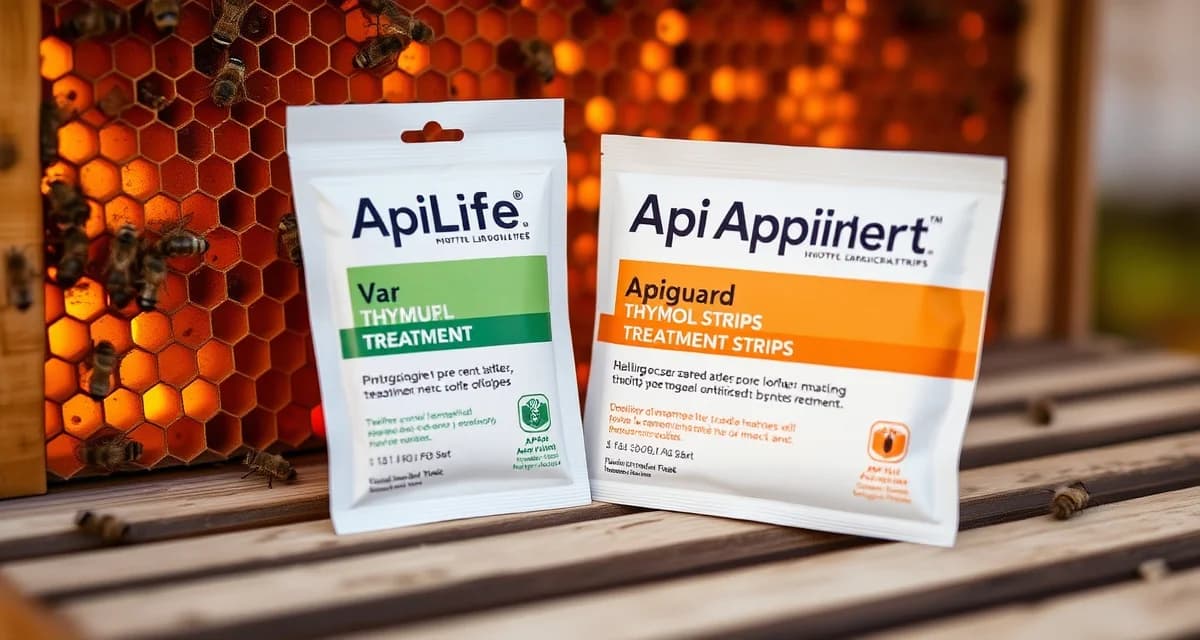
Thymol Varroa Treatment Guide: ApiLife Var and Apiguard
Thymol works. When the temperature is right, it's one of the more effective organic options available to beekeepers, with efficacy that competes with synthetic treatments under ideal conditions. The problem is that temperature window is narrower than most beekeepers realize.
Thymol efficacy drops to near zero when temperatures fall below 60 degrees Fahrenheit during treatment. In many parts of the US, that means spring and fall applications are unreliable. Thymol is a warm-season organic, most effective in late spring through early fall in regions that support it.
Understanding the temperature requirements is the first step. Understanding how ApiLife VAR and Apiguard differ is the second. And knowing how to track your applications against your efficacy outcomes is what separates a thymol treatment program that works from one that seems like it's working.
TL;DR
- Thymol-based treatments (Apiguard, ApiLife VAR) require sustained temperatures above 59 degrees F to vaporize effectively
- Apply in two rounds 1-2 weeks apart; the two-round protocol targets mites emerging from brood between applications
- Thymol does not penetrate capped brood cells, so the repeat application is essential for efficacy
- Efficacy ranges from 80-93% under proper temperature conditions; cool weather reduces effectiveness
- Thymol has no PHI for honey supers when used according to label -- confirm with your specific product label
- Track application temperature ranges alongside efficacy in VarroaVault to correlate temperature with treatment outcomes
How Thymol Kills Varroa
Thymol is a naturally occurring plant compound, the primary active ingredient in thyme oil, that acts as a fumigant acaricide. It volatilizes from the strip or gel, filling the hive with vapor that damages varroa mites' respiratory system.
The volatilization rate is temperature-dependent. Too cold and the thymol doesn't vaporize sufficiently. Too hot and the concentration becomes irritating or even harmful to bees. The labeled temperature window reflects this balance.
Mites killed by thymol are exposed in both the phoretic phase (on adult bees) and, to a limited extent, in capped cells, though cell penetration is less reliable than with formic acid. This makes thymol a moderate-brood treatment option, better than OA in colonies with brood, but not as effective as formic acid in fully penetrating sealed cells.
ApiLife Var vs. Apiguard: What's the Difference?
Both products use thymol as the primary active ingredient, but they differ in format, dosing, and application schedule.
ApiLife Var
ApiLife Var comes as tablets. Each tablet contains thymol blended with eucalyptol, menthol, and camphor, a mixture that some beekeepers find improves distribution through the colony.
Application: Break each wafer into 4 pieces and place around the perimeter of the top brood box frames. Replace every 7-10 days for 3 total applications (roughly 30 days total treatment).
Temperature window: 59-95°F (15-35°C). Below 59°F, expect very limited efficacy.
PHI: Check your current label, thymol products have variable PHI guidance. Many formulations specify no PHI when used according to label. Confirm before treating with supers on.
Apiguard
Apiguard comes in gel form (aluminum trays). The gel releases thymol slowly from the tray placed above the brood frames.
Application: Place one 50g tray above the brood frames for 2-week intervals. Two applications total (4 weeks minimum treatment).
Temperature window: 59-105°F (15-40°C). The gel format handles higher temperatures slightly better than tablets, but low-temperature performance is similar.
PHI: Check the current label. Generally not recommended with supers in place during treatment.
The main practical difference: ApiLife Var requires breaking tablets and distributing pieces; Apiguard is simpler, open the tray and place it. Many beekeepers find Apiguard easier to use consistently, especially across multiple colonies.
Temperature Requirements: Non-Negotiable
What temperature is required for thymol treatments? The lower limit is 59°F (15°C) and this applies throughout the treatment period, not just during application.
If nighttime lows are dropping below 60°F in your area, thymol is not appropriate. Period.
This has real calendar implications. In most northern US states, spring thymol treatment is unreliable before late May, and fall applications become unreliable after mid-September. In southern states, the window is longer but summer heat has its own concerns, above 95°F (35°C), thymol concentration can become problematic for bees.
VarroaVault's temperature compliance alert flags thymol treatments attempted below 59 degrees Fahrenheit where efficacy drops meaningfully. Before you log a thymol treatment, the app checks your local forecast against the treatment window, not just the current temperature, but the projected range through the treatment period.
Practical Calendar for Thymol Treatment
Northern US (Zones 4-6):
- Spring: Viable from approximately mid-May to June
- Summer: June-August (watch for heat above 95°F)
- Fall: August through early September (depending on when temperatures drop)
Southern US (Zones 7-9):
- Spring: April through May
- Summer: Mixed, may be too hot in July-August in some regions
- Fall: September through October viable in many areas
Pacific Northwest: Temperature variability makes thymol scheduling tricky. Western Oregon and Washington have cooler summers that support thymol well; eastern regions are hotter and drier.
Check your specific local forecast window, not just average temperatures, before starting any thymol treatment.
Does VarroaVault Track ApiLife Var Strip Replacement Reminders?
Yes. When you log an ApiLife Var treatment, you enter the first application date and select the treatment format (ApiLife Var or Apiguard). VarroaVault schedules replacement reminders at the correct intervals:
- ApiLife Var: Reminders at day 7-10 and day 14-20 for the second and third wafer replacements
- Apiguard: Reminder at day 14 for the second tray
You also get a post-treatment count reminder approximately 2 weeks after the final application, so you can verify efficacy against your baseline.
Pre-Harvest Interval and Super Status
Thymol products vary on PHI guidance. Some formulations list a 0-day PHI; others recommend removing supers during treatment. Always check the current label for your specific registered product.
The general caution: thymol in high concentrations can impart a detectable odor to honey if supers are on during heavy-release periods. This is most pronounced in the first week of treatment with ApiLife Var. Some beekeepers remove supers during the first application and replace them afterward; others run the full treatment without supers.
For your specific PHI and super status questions, the [pre-harvest interval tracker](/pre-harvest-interval-tracker) logs your treatment dates and calculates harvest timing based on the product you used.
Thymol Efficacy: What to Expect
Under ideal conditions (temperature in range throughout treatment, good colony ventilation, proper strip/gel placement):
- ApiLife Var: 80-93% mite reduction in documented studies
- Apiguard: 75-95% mite reduction in documented studies
Results in practice vary more widely than those ranges suggest, primarily because temperature compliance during the full treatment period is hard to guarantee in variable weather. A warm-start treatment that hits a cold snap at day 10 delivers much lower efficacy than the study conditions.
This is why post-treatment counting matters: don't assume thymol worked because you completed the application schedule. Count 2 weeks after the final strip/tray to verify.
What temperature is required for thymol treatments?
The minimum effective temperature for thymol treatments is 59°F (15°C), and this applies throughout the entire treatment period, not just the day of application. Below this threshold, volatilization is insufficient for effective mite control. The upper limit is approximately 95-105°F (35-40°C) depending on the product. Before starting thymol treatment, check a full 2-week forecast for your area. A treatment started in good conditions that hits a cold snap midway through will deliver considerably reduced efficacy.
How does ApiLife Var differ from Apiguard?
ApiLife Var comes as tablets broken into pieces and distributed around the top of the brood box, replaced every 7-10 days for 3 applications over roughly 30 days. Apiguard comes as a gel in aluminum trays placed above the brood nest, with one application per 14-day period for 2 applications over 4 weeks. Both use thymol as the primary active ingredient. Apiguard is somewhat easier to apply consistently; ApiLife Var's multi-compound formula may improve distribution in some hive configurations. Efficacy is comparable when both are applied in the correct temperature window.
Does VarroaVault track ApiLife Var strip replacement reminders?
Yes. Logging an ApiLife Var or Apiguard treatment in VarroaVault starts a reminder sequence at the correct replacement intervals for each product, days 7-10 and 14-20 for ApiLife Var wafer replacements, day 14 for the Apiguard second tray. A post-treatment count reminder fires approximately 2 weeks after your final application. Temperature compliance is checked against your local forecast when you log the treatment start date.
How do I know if my varroa treatment is working?
Run a mite count 2-4 weeks after the treatment ends and compare it to your pre-treatment count. The efficacy formula is: ((pre-count - post-count) / pre-count) x 100. A result above 90% indicates effective treatment. Results below 80% should trigger investigation for possible resistance, application error, or reinfestation. Log both counts in VarroaVault to track efficacy trends across treatment cycles.
How often should I check mite levels in my hives?
At minimum, once per month (every 3-4 weeks) during the active season. Increase to every 2 weeks when counts are near threshold or after a treatment to verify it worked. In fall, monitoring frequency matters most because the window to treat before winter bees are raised is narrow. VarroaVault's monitoring reminders can be set to your preferred interval for each apiary.
What records should I keep for varroa management?
Each record should include: date of count or treatment, hive identifier, monitoring method used, number of bees sampled, mites counted, infestation percentage, treatment product name and EPA registration number, dose applied, treatment start and end dates, and PHI end date. State apiarists typically expect this level of detail during inspections. VarroaVault captures all of these fields in a single log entry.
Related Articles
FAQ
What is Thymol Varroa Treatment Guide: ApiLife Var and Apiguard?
Thymol varroa treatment uses thymol, a natural compound derived from thyme, to control Varroa destructor mites in honeybee colonies. ApiLife VAR and Apiguard are the two main commercial products. Both work by slowly releasing thymol vapor inside the hive, which kills mites on adult bees. They differ in formulation and application method, but both require sustained temperatures above 59°F and a two-round treatment protocol to achieve meaningful efficacy.
How much does Thymol Varroa Treatment Guide: ApiLife Var and Apiguard cost?
Thymol-based treatments are generally affordable compared to synthetic options. Apiguard gel packs typically run $3–6 per treatment dose, while ApiLife VAR wafers cost roughly $2–4 each. A full two-round course for a single hive usually costs under $15 in product alone. Prices vary by supplier and quantity purchased. Neither product requires a veterinary prescription, which keeps costs lower than some prescription-only synthetics.
How does Thymol Varroa Treatment Guide: ApiLife Var and Apiguard work?
Thymol vaporizes at warm temperatures and the resulting vapor kills Varroa mites on contact as bees move through the hive. The compound does not penetrate capped brood cells, so mites sheltering inside cells survive the first application. A second application 1–2 weeks later targets mites that have emerged from brood during that window. The two-round protocol is essential — skipping the second treatment significantly reduces overall mite kill.
What are the benefits of Thymol Varroa Treatment Guide: ApiLife Var and Apiguard?
Thymol treatments are organic, leave no synthetic residues in wax or honey, and are approved for use in certified organic operations. They are effective alternatives when mites show resistance to synthetic miticides like amitraz or oxalic acid. When applied correctly during appropriate temperatures, efficacy competes with synthetic treatments. They also carry low toxicity risk to bees when used within label guidelines and temperature ranges.
Who needs Thymol Varroa Treatment Guide: ApiLife Var and Apiguard?
Any beekeeper managing Varroa mites in climates that support warm seasonal temperatures should consider thymol treatments. They are particularly well-suited for beekeepers who prioritize chemical-free or low-residue management, those whose mite populations have developed resistance to synthetics, and operations seeking to rotate treatment classes to prevent resistance buildup. Beekeepers in consistently warm regions get the most reliable results from thymol-based protocols.
How long does Thymol Varroa Treatment Guide: ApiLife Var and Apiguard take?
A single Apiguard or ApiLife VAR application remains active in the hive for approximately 1–2 weeks before needing replacement. The complete two-round treatment course typically spans 3–4 weeks from first application to removal of the final dose. Actual duration depends on temperature, hive ventilation, and product-specific label instructions. Treatment should not begin if sustained temperatures will drop below 59°F during the treatment window.
What should I look for when choosing Thymol Varroa Treatment Guide: ApiLife Var and Apiguard?
Prioritize temperature compatibility with your local climate — thymol becomes unreliable below 60°F and can harm bees above 105°F. Choose between ApiLife VAR wafers and Apiguard gel based on your hive configuration and application preference. Verify the product is registered for use in your state. Track mite counts before and after treatment to confirm efficacy. Follow label instructions precisely, including entrance reduction and timing between applications.
Is Thymol Varroa Treatment Guide: ApiLife Var and Apiguard worth it?
For beekeepers in appropriate climates, thymol treatments are absolutely worth it. They offer strong mite control without synthetic residues, support resistance management when rotated with other treatment classes, and are cost-effective. The limitation is the narrow temperature window, which makes them unreliable in cooler climates or during unpredictable spring and fall conditions. If your region supports sustained warm temperatures during treatment periods, thymol is one of the more reliable organic options available.
Sources
- American Beekeeping Federation (ABF)
- USDA ARS Bee Research Laboratory
- Honey Bee Health Coalition
- Penn State Extension Apiculture Program
- Project Apis m.
Get Started with VarroaVault
Thymol treatment efficacy depends heavily on temperature during application. VarroaVault logs your treatment dates alongside post-treatment counts so you can see whether your thymol applications delivered expected results in your climate. See pricing and free tools at varroavault.com.