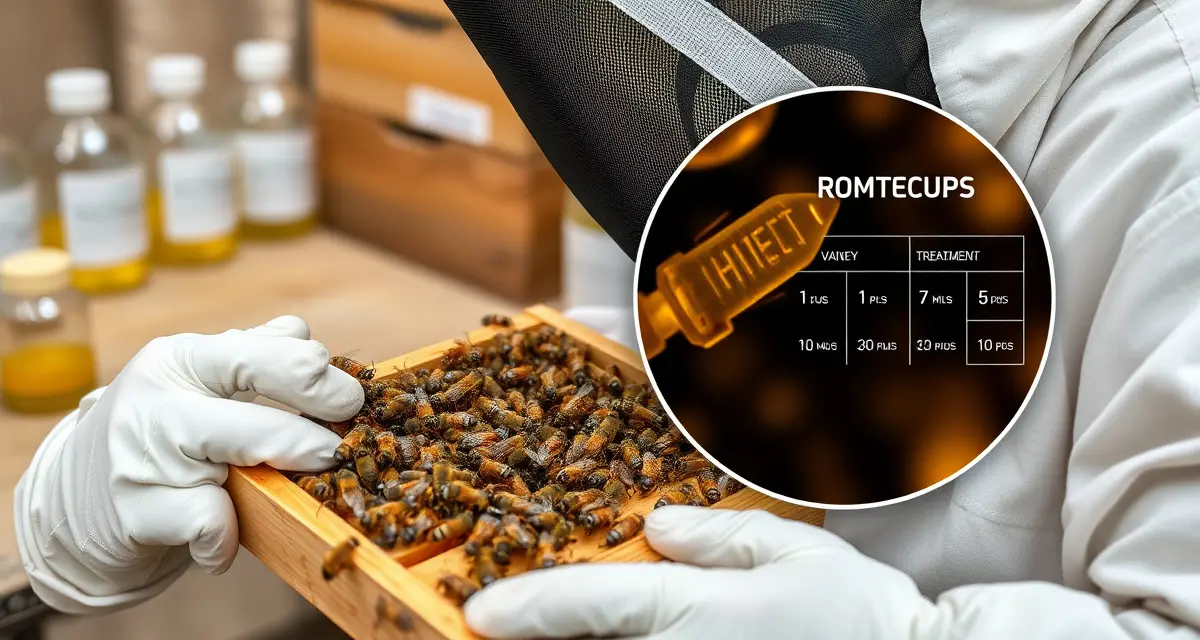
Planning Treatment Rotation to Prevent Varroa Mite Resistance
Treatment rotation is one of the most important and most neglected aspects of varroa management. Many beekeepers find a product that works, repeat it every cycle, and eventually wonder why their mite counts are not dropping the way they used to. The answer is usually resistance that developed gradually over multiple seasons of selection pressure from a single active ingredient.
The Modes of Action in Your Toolkit
There are five active ingredients registered for varroa control in the United States, and they work through different mechanisms:
Amitraz (Apivar) is a neurotoxin that affects octopamine receptors, disrupting the mite's nervous system. It is the most widely used varroa miticide in the US and has the most documented resistance cases globally.
Oxalic acid (OAV, Api-Bioxal drench) works by direct contact toxicity. It appears to affect the mite's cuticle and creates an osmotic stress. Resistance to oxalic acid in field populations remains rare but has been documented in heavily treated European populations.
Formic acid (MAQS, Formic Pro) penetrates brood cappings and kills mites in the reproductive phase as well as phoretic mites. Its mechanism involves disruption of enzyme systems sensitive to acid conditions.
Thymol (Apiguard, Api Life Var) is a volatile organic compound that acts as a contact and vapor-phase toxicant. It is less effective in cool conditions and works best at temperatures above 60 degrees Fahrenheit.
Beta acids (Hopguard II) are derived from hops. Their mechanism is less well characterized but appears to affect mite reproduction.
Rotating among products with different modes of action means that even if a subpopulation of mites develops some tolerance to one active ingredient, it will not be cross-tolerant to others. Selection pressure is reset with each product switch.
Designing a Two-Year Rotation
A practical rotation covers the major treatment opportunities across two full years and cycles through at least three different active ingredients. Here is a workable template for northern US operations:
Year 1, early spring (before main flow): Apiguard or Api Life Var (thymol). Apply in April when temperatures allow. Remove before honey supers go on.
Year 1, midsummer (during flow, if needed): MAQS (formic acid). Can be used with supers on. Apply if counts exceed threshold during the production season.
Year 1, late summer / fall (post-harvest): Apivar (amitraz). Strips in after the last super comes off in August. Full 6 to 8 week course.
Year 1, winter broodless period: OAV (oxalic acid). One treatment during confirmed broodlessness, or three treatments 5 days apart if any brood remains.
Year 2, early spring: Hopguard II (beta acids). Apply before the spring flow.
Year 2, midsummer: OAV under brood-on conditions if counts rise, or MAQS.
Year 2, late summer / fall: Apivar again is acceptable here since it was last used in Year 1 fall, a full year prior.
Year 2, winter: OAV during broodless period.
This rotation uses amitraz once per year, oxalic acid twice per year in different contexts, and cycles through formic acid, thymol, and beta acids in alternating positions. No active ingredient is used in consecutive major treatment cycles.
Tracking What You Have Used
A rotation plan is only as good as the records that confirm you are actually following it. Without documentation, "rotating treatments" often means remembering roughly what you used last year and guessing from there. This is how beekeepers end up using Apivar three cycles in a row without realizing it.
Your treatment records should capture the active ingredient, not just the brand name. Apivar and amitraz strips from other suppliers both contain amitraz. Tracking by active ingredient gives you a clearer picture of selection pressure than tracking by product name.
VarroaVault's treatment log captures both product name and active ingredient, and the rotation view shows you the sequence of treatments over time for any hive or apiary. When you see amitraz appearing in two consecutive fall treatment slots, the record flags the deviation from your rotation plan. The treatment history is visible across multiple seasons so you can catch drift before it becomes a resistance problem.
Regional and Seasonal Adjustments
Your rotation needs to work within the constraints of your region's climate and your operation's timing. In the southeastern US, where there is no reliable natural broodless period, OAV during broodlessness is not a standard tool. The rotation there relies more heavily on Apivar, MAQS, and thymol, with more emphasis on induced brood breaks via splits.
In northern regions with strong winter broodless periods, OAV becomes a core component of the rotation. Adjust your template to fit your climate rather than following a generic schedule that was designed for different conditions.
See the treatment temperature restrictions guide for the operating windows of each product, which also affects which rotations are practical in your region.
When to Break From Your Rotation
The plan is a guideline, not a rigid prescription. If your mite counts are elevated after a treatment and you need to retreat quickly, you may need to use the same product twice in a row in an emergency. This is acceptable in the short term. What matters is returning to the rotation as quickly as possible afterward.
Document any rotation breaks with the reason. A note that says "Used Apivar again in spring due to elevated post-winter counts, returning to thymol in midsummer" gives future you the context to understand the history and assess whether the break created a resistance risk.
FAQ
What is Planning Treatment Rotation to Prevent Varroa Mite Resistance?
Treatment rotation for varroa mite management is the practice of alternating between miticides with different modes of action across treatment cycles. Instead of repeating the same active ingredient season after season, beekeepers cycle through amitraz, oxalic acid, formic acid, thymol, and other registered treatments. This prevents any single mechanism of resistance from becoming established in the local mite population, preserving the long-term effectiveness of every tool in your toolkit.
How much does Planning Treatment Rotation to Prevent Varroa Mite Resistance cost?
Treatment rotation itself costs nothing beyond the products you are already buying. The individual miticides range from roughly $10 for oxalic acid treatments on a single hive to $30–$50 for formic acid strips or amitraz strips per colony. Rotating between them does not add to your total spend — it just changes which product you purchase each cycle. The real cost of not rotating is losing efficacy and facing resistant mite populations that require more frequent intervention.
How does Planning Treatment Rotation to Prevent Varroa Mite Resistance work?
Treatment rotation works by denying varroa mites sustained selection pressure from any one active ingredient. Each miticide kills mites through a distinct biological mechanism — amitraz disrupts octopamine receptors, oxalic acid damages the cuticle, formic acid disrupts enzyme systems, and thymol interferes with the nervous system differently than amitraz. Switching mechanisms between cycles means any mites that survived one treatment due to partial resistance are unlikely to also survive the next, slowing or preventing resistance from spreading through the population.
What are the benefits of Planning Treatment Rotation to Prevent Varroa Mite Resistance?
The primary benefit is preserving long-term miticide efficacy. Beekeepers who rotate treatments rarely see the sudden drop in effectiveness that signals resistance. Secondary benefits include broader mite kill across life stages — some treatments target phoretic mites, others penetrate brood — giving more complete control. Rotation also reduces chemical residue buildup from any single compound in wax and honey, which matters for both bee health and product quality.
Who needs Planning Treatment Rotation to Prevent Varroa Mite Resistance?
Any beekeeper treating for varroa needs a rotation plan, but it is most critical for those who have been keeping bees for three or more years and have consistently used the same miticide. Operations in regions with high hive density face faster resistance development due to mite migration between colonies. Commercial and sideliner beekeepers treating dozens of hives are at especially high risk, since they apply large volumes of one product repeatedly, creating strong local selection pressure.
How long does Planning Treatment Rotation to Prevent Varroa Mite Resistance take?
Planning a rotation takes under an hour — you map your treatment windows across the year and assign a different active ingredient to each one. Executing the plan follows your normal treatment schedule, typically two to three cycles per year depending on your climate and mite pressure. Brood-break treatments with oxalic acid can be done in as little as one day, while strip-based treatments like Apivar or Formic Pro run three to eight weeks per cycle.
What should I look for when choosing Planning Treatment Rotation to Prevent Varroa Mite Resistance?
Look for a rotation plan that covers at least two distinct modes of action per season and never repeats the same active ingredient in back-to-back cycles. Ensure each chosen product is registered for use in your region and suits your local climate — thymol and formic acid have temperature constraints. Prioritize products with clear resistance monitoring data so you can respond quickly if efficacy drops. Cross-reference your rotation with mite count records to verify each treatment is actually working.
Is Planning Treatment Rotation to Prevent Varroa Mite Resistance worth it?
Yes, treatment rotation is worth it for any beekeeper who wants to keep varroa manageable long-term. The alternative — repeating a single miticide — has a documented endpoint: resistance. Beekeepers in parts of Europe and North America who relied heavily on amitraz are already seeing reduced efficacy. Rotating treatments is a low-effort, no-extra-cost strategy that protects your investment in both products and colonies. The small planning effort upfront prevents the much larger crisis of losing effective treatment options entirely.