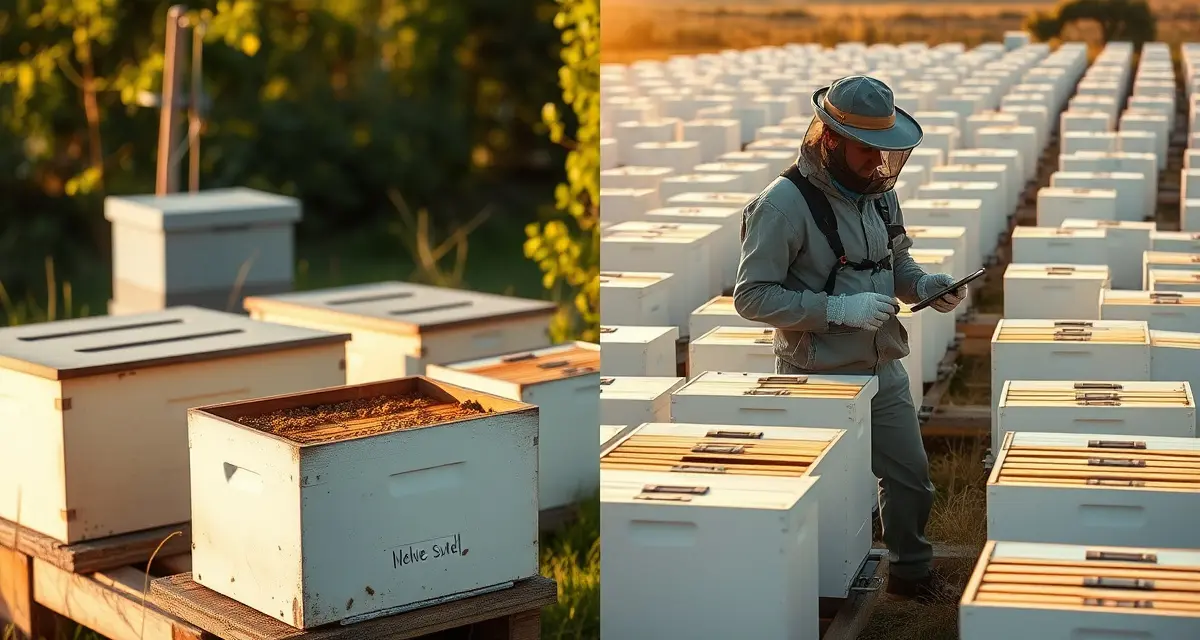
Hobby vs Commercial Varroa Management: How the Approach Differs
Commercial beekeepers spend an average of 18x more time on varroa management than hobby beekeepers due to scale, not complexity per hive. That distinction matters: managing varroa is not harder at 200 hives than at 5. The biology is identical, the thresholds are the same, and the treatment products are the same. What's different is the systems required to manage that biology at scale -- and those systems change gradually as you grow.
This guide maps how varroa management evolves from a 3-hive hobby operation to a 200-hive commercial one, so you can identify where you are and what upgrade your operation actually needs.
TL;DR
- Commercial operations managing 50+ hives cannot rely on per-hive manual records without significant time investment
- Treatment efficacy must be tracked across yards, not just individual hives, to detect resistance patterns
- USDA APHIS and state apiarists increasingly request documented treatment protocols for commercial inspections
- PHI compliance across multiple apiaries and multiple treatments requires a systematic tracking system
- VarroaVault's commercial tier supports multi-yard management with yard-level reporting and bulk data entry
- Generating a treatment history report for all apiaries takes under 60 seconds in VarroaVault
Hobby Beekeeping: 1-10 Hives
At this scale, individual attention to every colony is both practical and appropriate. You can do an alcohol wash on every hive in an afternoon, keep track of every colony's status in your head (though you shouldn't), and treat hives individually when needed.
What works at hobby scale:
- Monthly alcohol wash on every hive from April through September
- Individual hive records in a notebook or simple app
- Treating individual hives when they cross threshold
- A single treatment product for the fall window, applied colony by colony
- PHI tracking in your head or a simple calendar
Where hobby beekeepers most often fail:
The record-keeping gap. Notebook records are inconsistent, treatment logs don't include all required fields, and post-treatment counts are skipped because there's no reminder system. The result is reactive rather than proactive management, missed fall windows, and undetected treatment failures.
VarroaVault's varroa mite software for hobby beekeepers is designed to fix this specific gap: it provides the reminder structure and threshold alerts that paper records can't.
Serious Hobby / Sideliner: 10-30 Hives
This is where the "I can keep it in my head" approach starts to break down. At 15-25 hives, you have too many colonies to track individually from memory, and the stakes are high enough that lost colonies represent real money.
What changes at 10-30 hives:
- Individual hive IDs become essential. You need to be able to track which colonies are high-mite over multiple seasons to identify outliers.
- Batch treatment planning replaces individual colony treatments. Treating your whole apiary on the same day is more efficient and ensures no hives get missed.
- Record-keeping needs to be systematic. You can't reconstruct treatment history from memory when your state apiarist asks to see your records for 20 hives.
- PHI tracking becomes a formal system. With honey from multiple hives, a missed PHI calculation on one colony creates real compliance risk.
The key system upgrade at this scale:
Move from a notebook to a digital tracking system. VarroaVault's hobby plan handles up to 10 hives; the professional plan handles unlimited hives with batch logging and batch treatment features that make managing 20-30 colonies significantly more efficient.
Small Commercial: 30-100 Hives
At this scale, you probably have multiple apiaries at different locations. Each location has its own honey flow timing, its own mite pressure, and its own PHI calendar. Managing them as a single unified operation creates compliance and management errors.
What changes at 30-100 hives:
- Per-location management becomes necessary. Each apiary needs its own records, its own treatment calendar, and its own PHI tracking.
- Staff may be involved. When someone else is doing counts or applying treatments, you need logged records with user attribution rather than relying on memory.
- State inspection compliance becomes formal. Inspectors at this scale are likely to scrutinize your records. Treatment logs need to be complete, accurate, and organized.
- Batch treatment day scheduling becomes critical. A 60-hive fall treatment event needs to be planned like a production day -- supplies ordered in advance, hives pre-listed, staff briefed, records set up to receive batch entries.
The key system upgrade at this scale:
VarroaVault Professional with location-based program management and crew access. The commercial beekeeper management software page covers all the features relevant to small commercial operations.
Medium Commercial: 100-300 Hives
Now you're in territory where monitoring every hive every month is impractical, and treatment day logistics require real planning. Representative sampling and sentinel hive programs replace full-apiary monthly monitoring. Staff coordination becomes a management challenge.
What changes at 100-300 hives:
- Representative sampling replaces 100% monitoring. Testing 10-15% of hives per apiary per month gives statistically valid apiary-level data without testing every colony.
- Sentinel hive programs provide early warning. Designated high-risk colonies monitored more frequently alert you to rising apiary-level pressure before full counts are needed.
- Treatment days are production-scale events. A 200-hive fall treatment may take 2-3 full team days across multiple apiaries. Scheduling, supply management, and batch record entry are all significant logistical tasks.
- PHI compliance at scale. With 200 hives across multiple honey production apiaries with different super timelines, PHI tracking becomes a spreadsheet or software problem.
What stays the same:
The biology, the thresholds, the treatment products, and the monitoring methods. You're managing the same mite in the same bee. The complexity is organizational, not biological.
What VarroaVault Professional Offers That Hobby Doesn't
The side-by-side plan comparison:
| Feature | Hobby ($29/mo) | Professional ($59/mo) |
|---|---|---|
| Hive count | Up to 10 | Unlimited |
| Multiple apiaries | 1 | Unlimited |
| Batch treatment logging | No | Yes |
| Crew access | No | Yes (up to 5 users) |
| Representative sampling tool | No | Yes |
| Sentinel hive designation | No | Yes |
| Location-specific calendars | No | Yes |
| Compliance export (state inspection) | Basic | Full (27 states) |
| Annual summary report | Yes | Yes, plus crew activity |
The upgrade from Hobby to Professional makes sense when you have more than 10 hives, multiple locations, or staff involved in your operation. The varroavault pricing page has the full feature comparison.
At What Hive Count Do You Need to Upgrade?
The honest answer is 10+ hives with multiple apiaries, or any scale where staff are involved. If all your hives are at one location and you're managing them yourself, the hobby plan works through 10 hives. If you're at 12-15 hives at a single location still managing solo, you can stretch the hobby plan -- but the missing batch logging and PHI calendar features will start creating friction.
If you have even one employee touching your hives or logging records, upgrade to Professional for the crew access features. Records entered by a staff member need to be attributed to that person for compliance purposes.
Frequently Asked Questions
How does varroa management change as I add more hives?
The biology and thresholds don't change -- it's still 2% in season, 1% before winter, regardless of whether you have 5 or 500 hives. What changes are the systems needed to manage that biology reliably. More hives require unique hive IDs, batch treatment planning, per-location records, and eventually representative sampling instead of full-apiary individual counts. Each transition point -- 10 hives, 30 hives, 100 hives -- introduces a new system requirement that the previous approach can't handle.
At what hive count do I need to upgrade from Hobby to Professional?
The functional threshold is 10 hives (the Hobby plan limit) or any scale with multiple apiaries or staff involvement. If you're managing 12-15 hives solo at one location, you can manage with the Hobby plan by accepting its limitations. If you have any staff doing apiary work, any multiple-location management, or any state inspection compliance requirements beyond a basic single-apiary check, Professional's additional features justify the upgrade immediately.
What does VarroaVault Professional offer that Hobby does not?
The key Professional features are: unlimited hive count (vs. 10 in Hobby), unlimited apiaries with location-specific treatment calendars, batch treatment and count logging for multi-hive apiary sessions, crew access for up to 5 users with individual credentials, sentinel hive designation for commercial-scale monitoring, representative sampling tools, full state inspection compliance export for 27 states, and expanded PHI tracking that manages multiple apiaries with different honey super timelines simultaneously.
How do I know if my varroa treatment is working?
Run a mite count 2-4 weeks after the treatment ends and compare it to your pre-treatment count. The efficacy formula is: ((pre-count - post-count) / pre-count) x 100. A result above 90% indicates effective treatment. Results below 80% should trigger investigation for possible resistance, application error, or reinfestation. Log both counts in VarroaVault to track efficacy trends across treatment cycles.
How often should I check mite levels in my hives?
At minimum, once per month (every 3-4 weeks) during the active season. Increase to every 2 weeks when counts are near threshold or after a treatment to verify it worked. In fall, monitoring frequency matters most because the window to treat before winter bees are raised is narrow. VarroaVault's monitoring reminders can be set to your preferred interval for each apiary.
What records should I keep for varroa management?
Each record should include: date of count or treatment, hive identifier, monitoring method used, number of bees sampled, mites counted, infestation percentage, treatment product name and EPA registration number, dose applied, treatment start and end dates, and PHI end date. State apiarists typically expect this level of detail during inspections. VarroaVault captures all of these fields in a single log entry.
What is Hobby vs Commercial Varroa Management: How the Approach Differs?
Hobby vs Commercial Varroa Management: How the Approach Differs is a guide published on VarroaVault that explains how varroa mite management strategies evolve as a beekeeping operation grows. It covers the key differences between managing a small hobby apiary of 3–5 hives versus a commercial operation of 50–200+ hives, focusing on record-keeping systems, treatment tracking, resistance monitoring, and regulatory compliance rather than the underlying biology, which remains the same at any scale.
How much does Hobby vs Commercial Varroa Management: How the Approach Differs cost?
This article is free educational content available on VarroaVault. The platform itself offers tiered plans, including a commercial tier that supports multi-yard management, yard-level reporting, and bulk data entry for operations managing 50 or more hives. Hobby beekeepers can access core varroa tracking features at a lower cost. Visit VarroaVault.com for current pricing on each plan tier.
How does Hobby vs Commercial Varroa Management: How the Approach Differs work?
The article walks beekeepers through how varroa management systems must adapt as hive numbers grow. At small scale, per-hive manual records work fine. As operations expand past 20–50 hives, yard-level tracking, treatment efficacy reporting, and PHI compliance across multiple apiaries become necessary. The guide helps beekeepers identify where their operation currently sits and what specific system upgrade — not biology change — they actually need next.
What are the benefits of Hobby vs Commercial Varroa Management: How the Approach Differs?
The primary benefit is clarity: hobby and commercial beekeepers often assume scale means greater complexity per hive, but the biology and thresholds are identical. Understanding this lets beekeepers invest effort in the right area — systems and documentation — rather than overthinking individual hive treatment. Commercial operators also benefit from learning how documented treatment protocols satisfy USDA APHIS inspections and help detect resistance patterns across yards early.
Who needs Hobby vs Commercial Varroa Management: How the Approach Differs?
This guide is useful for any beekeeper planning to grow beyond a small hobby operation, currently managing 20 or more hives, or facing commercial inspections that require documented treatment histories. It is also relevant for hobby beekeepers who want to adopt better record-keeping habits early, and for commercial operators looking to streamline compliance with state apiarists and PHI tracking across multiple apiaries and treatment types.
Sources
- American Beekeeping Federation (ABF)
- USDA ARS Bee Research Laboratory
- Honey Bee Health Coalition
- Penn State Extension Apiculture Program
- Project Apis m.
Get Started with VarroaVault
Commercial beekeeping operations need a varroa management system that scales across yards, generates compliance-ready reports, and flags resistance before it costs you colonies. VarroaVault was built for exactly this kind of multi-apiary operation. Start your free trial at varroavault.com and see how it fits your operation.